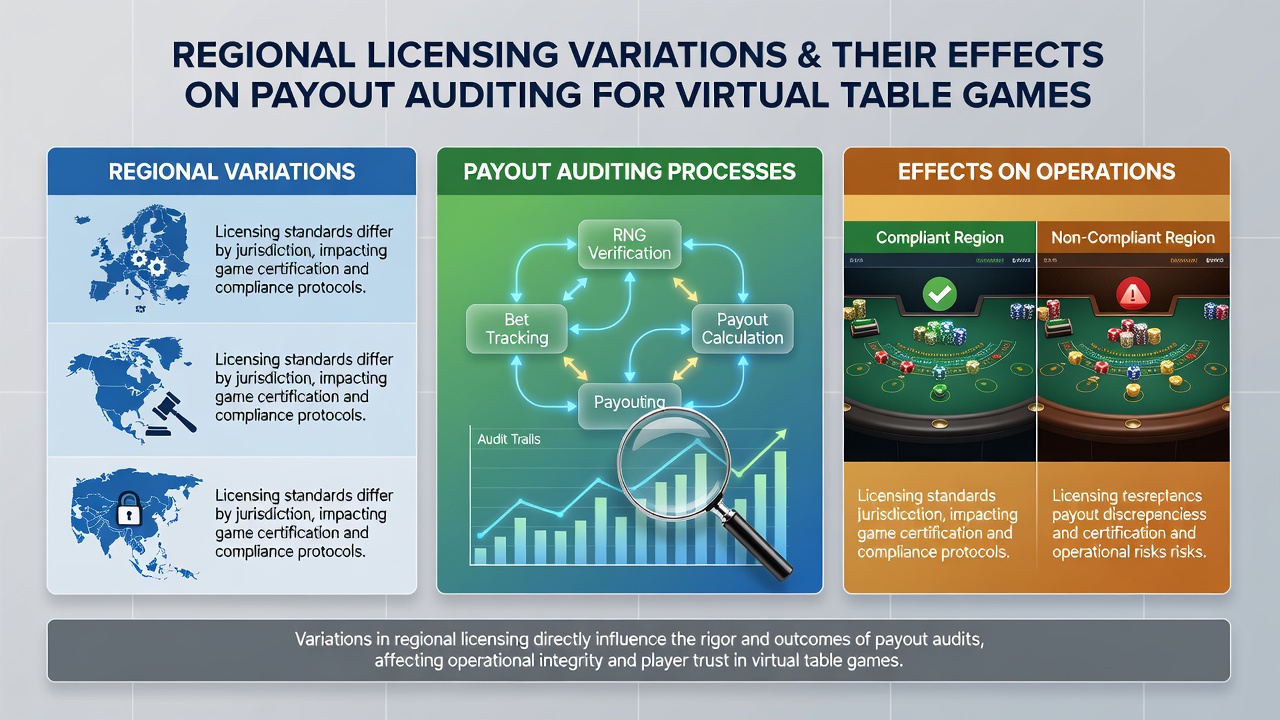
Regional Licensing Variations and Their Effects on Payout Auditing for Virtual Table Games
Virtual table games operate under licensing systems that shift sharply from one jurisdiction to another, and those differences directly shape how payout audits get conducted and enforced. Operators must navigate separate rules on return-to-player verification, independent testing frequency, and documentation standards, which creates layered compliance requirements rather than a single uniform process.
Key Differences in Licensing Structures
Jurisdictions such as New Jersey and Pennsylvania maintain state-level oversight that ties licensing approval to specific technical audits performed by approved laboratories, while European regulators often require centralized reporting through national gaming authorities with quarterly data submissions. Ontario's iGaming framework adds another layer by mandating real-time data feeds to the Alcohol and Gaming Commission of Ontario, which then coordinates with third-party auditors for payout calculations. These structural distinctions mean an operator running the same blackjack or roulette variant across borders faces distinct audit timelines and formats rather than one consolidated review.
How Audit Requirements Diverge by Region
Payout auditing focuses on confirming that game outcomes match declared return-to-player percentages, yet the methods and intervals vary. Some licensing bodies demand monthly submission of raw game logs for statistical analysis, whereas others accept aggregated monthly reports reviewed on a semi-annual basis. In regions where licensing ties directly to continuous monitoring systems, auditors receive automated alerts when payout ratios deviate beyond predefined thresholds, triggering immediate investigations. Elsewhere, audits occur only after scheduled license renewals, which can extend the gap between verification points. Data from the New Jersey Division of Gaming Enforcement shows that licensed platforms undergo RNG certification and payout testing at intervals tied to license renewal cycles, producing a documented trail of compliance checks.
Impact on Multi-Jurisdictional Operators
Operators holding licenses in multiple territories must maintain separate audit trails that satisfy each regulator's format and timing rules, which increases administrative overhead and requires specialized compliance teams. A platform offering virtual baccarat across North American and Asian markets, for instance, may need to store payout data in jurisdiction-specific repositories while also submitting translated summaries to meet local language requirements. This fragmentation can delay payout verification when cross-border discrepancies appear, because auditors in one region cannot automatically access records validated by another authority. Industry reports indicate that such coordination challenges have prompted several operators to segment their game libraries by licensing zone rather than running unified versions worldwide.
Recent Regulatory Updates and July 2026 Context
By July 2026 several jurisdictions had introduced updated technical standards that further differentiate audit protocols. Certain U.S. states incorporated mandatory blockchain-based logging for virtual table game transactions, allowing auditors to verify payout integrity through immutable records instead of traditional log files. Meanwhile, regulatory bodies in parts of Europe and Australia refined their testing intervals to align with updated risk assessments that consider game volatility metrics. These changes mean operators must update their internal audit software and reporting pipelines to remain compliant across all active licenses. Observers note that platforms already equipped with flexible data architectures adapted more quickly, whereas those with rigid legacy systems faced extended review periods during license renewals.
Consequences for Payout Verification Consistency
Because each licensing framework sets its own tolerance levels for statistical variance in payouts, a single game title can produce slightly different verified return-to-player figures depending on the jurisdiction conducting the audit. This variation arises from differences in sample size requirements and the statistical models regulators accept. When operators publish payout percentages, they must therefore specify the licensing region attached to each figure to avoid misinterpretation by players or oversight bodies. Research from gaming technology institutes shows that aligning multiple regional datasets requires additional normalization steps before consolidated reports can be generated for internal use.
Conclusion
Regional licensing variations continue to drive distinct approaches to payout auditing for virtual table games, creating a landscape where operators and auditors alike adapt procedures to match each jurisdiction's technical and reporting mandates. As markets evolve through 2026 and beyond, the need for interoperable systems that satisfy multiple oversight frameworks remains a central operational consideration across the sector.